Introducing ANCI: The Agent Infrastructure for Scheduling
Today we are introducing ANCI, the agent infrastructure for scheduling. Built on six years of TEAMCAL AI, ANCI is how we hire scheduling work to named agents instead of buying more software. Meet Zara, Ray, and the rest of the family.

I stopped doing my own scheduling years ago.
If you are an executive reading this, you probably did too. Your EA runs your calendar. Your recruiter runs the interview loops. Your sales ops lead runs the prospect calls. The pattern is consistent across every company we work with: somewhere in the last decade, the executive class collectively decided that calendar work was not something we were going to do ourselves anymore.
But the work did not go away. It got handed to people. Talented people, doing what is mostly coordination work, at salaries that reflect their seniority. A senior EA in San Francisco costs about $110,000 fully loaded. A recruiting coordinator costs about $75,000. Most of what they do day-to-day is move time around between people who are too busy to do it themselves.
Today I am introducing ANCI. It is the agent infrastructure for scheduling, and it is the next step in what we have been building at TEAMCAL AI since 2020.
What ANCI is
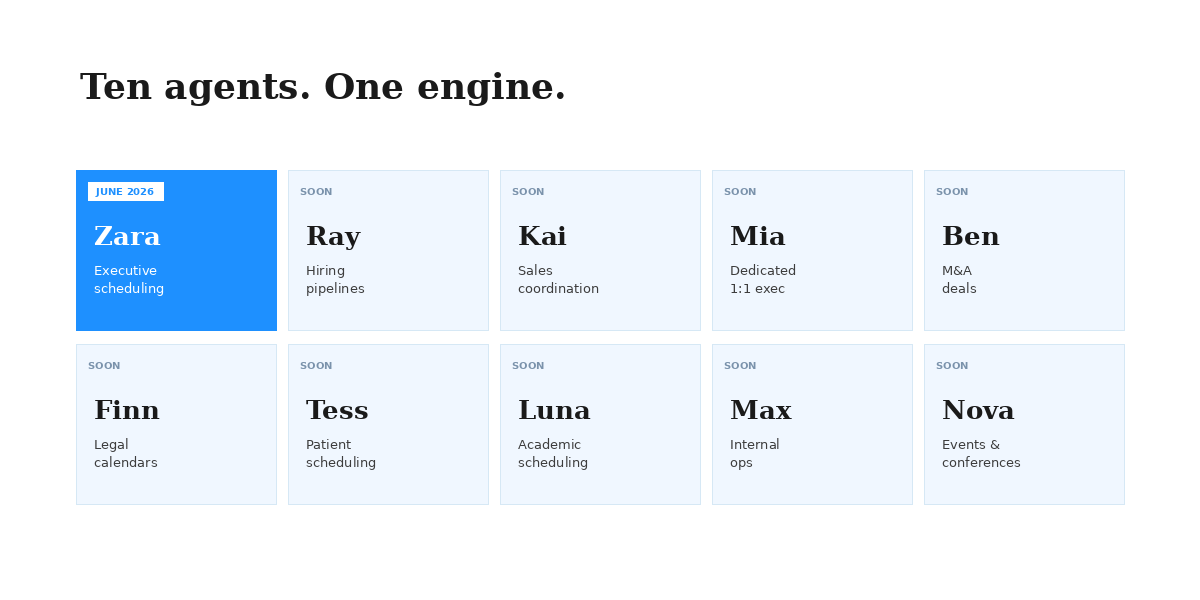
ANCI is a family of scheduling agents you hire by name. Each agent has a job. Each agent has a price. Each agent serves a whole team, not a single user.
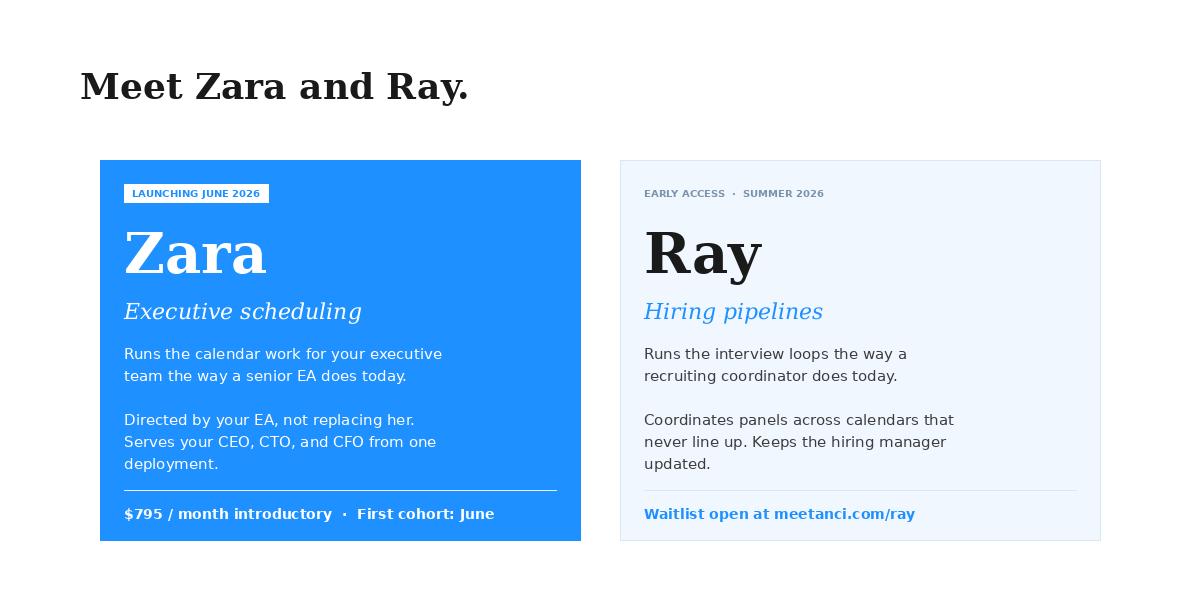
The first is Zara. Zara runs executive scheduling, the way a senior EA does today. She handles the back-and-forth, the calendar geometry, the cross-time-zone coordination, the reschedule requests that come in at 9 PM, the recurring meeting hygiene. She works alongside your EA, not in place of her. Your EA directs Zara the way a partner directs an associate. Zara does the work; your EA keeps the relationships.
The second is Ray. Ray runs hiring pipelines. He coordinates interview loops, manages candidate communication, books panels across calendars that never line up, and keeps the hiring manager updated. Your recruiter directs Ray the way a recruiting lead directs a coordinator.
Behind Zara and Ray are eight more agents, each built for a specific vertical: Kai for sales coordination, Mia for dedicated executive scheduling, Ben for M&A deal coordination, Finn for legal calendars, Tess for healthcare patient scheduling, Luna for academic scheduling, Max for internal operations, and Nova for events. Together they make up the ANCI family.
How we got here
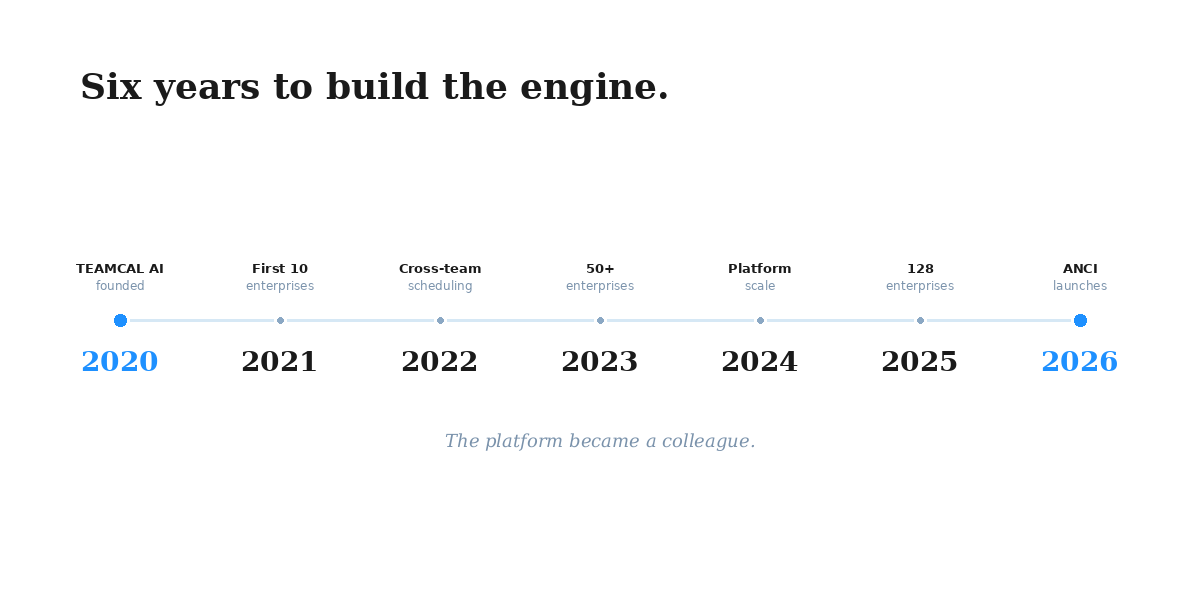
ANCI did not start as ANCI. It started as TEAMCAL AI.
In 2020, we started TEAMCAL AI to solve a specific problem: scheduling across teams was broken. Existing tools were built around individual calendars. Real work happened across teams, across companies, across time zones. The gap between how scheduling tools worked and how teams actually scheduled created the friction every EA, every recruiter, every sales rep already knew about and quietly resented.
We built TEAMCAL AI as the platform underneath. The engine. We added customers slowly, learned what they actually needed, and refused to ship anything that did not make their work meaningfully better. Six years later, 128 enterprises across 90 countries run their scheduling on TEAMCAL AI. Roughly 3,000 users. Recruiters, EAs, founders, ops leaders, sales teams, executives.
A pattern emerged that we did not initially design for. The platform got more powerful. The users got more skilled. And somewhere around year four, we noticed that the most effective TEAMCAL AI users were not using it as a tool. They were using it as a colleague. They were assigning work to it. They were trusting it to handle things they would have otherwise done themselves.
The platform we built to schedule across teams had quietly become the platform you direct to schedule across teams. That is when we started building Zara.
Why a second brand
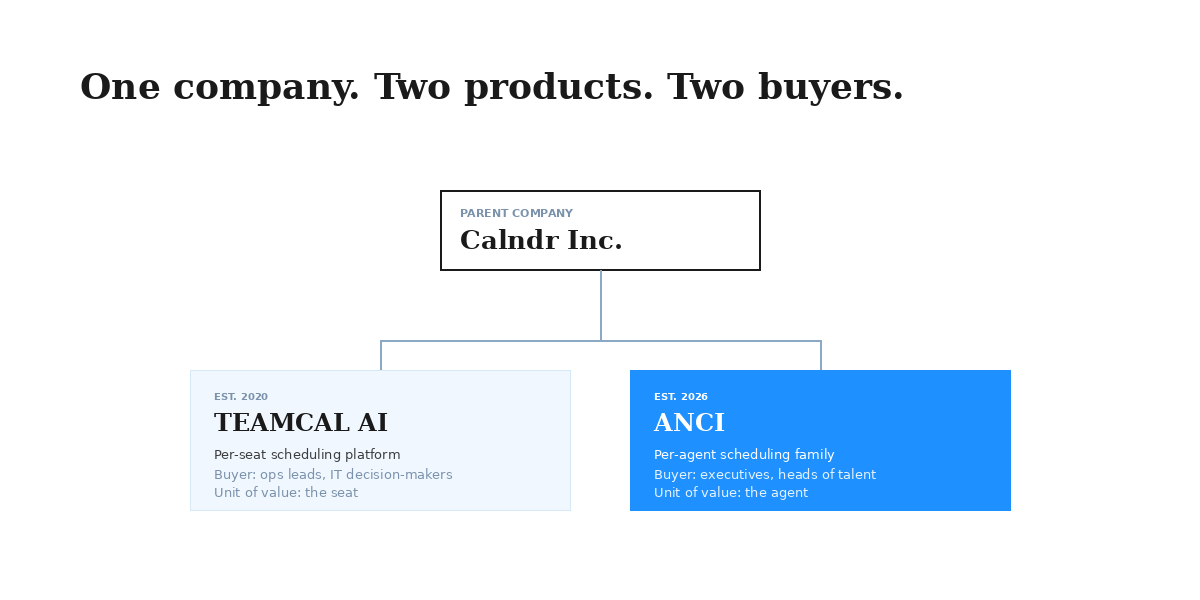
The honest answer for why we are introducing ANCI as a new brand instead of just shipping a new feature inside TEAMCAL AI: the buyer is different.
TEAMCAL AI is sold per seat to teams who want a scheduling platform. The buyer is usually an ops lead or an IT decision-maker buying a tool their team will use. The unit of value is the seat.
ANCI is sold per agent to companies who want to hire a specific scheduling worker. The buyer is the executive whose calendar is broken, or the head of talent whose hiring loops are slowing the company down. The unit of value is the agent.
Different unit of sale. Different buyer mental model. Different sales motion. Different price point. Different mental category in the buyer's head.
Forcing one customer to understand the other does not help either of them. Two brands let us tell each story clearly, to the people who need to hear it.
The companies are the same. ANCI is operated by Calndr Inc., the same legal entity that has operated TEAMCAL AI since 2020. Same engineering team. Same security posture. Same data architecture. Same legal agreements. ANCI agents are powered by the TEAMCAL AI engine underneath. If you sign a contract with us today, you get one entity to deal with, one set of credentials, one team to call.
But the products are different. TEAMCAL AI continues to exist, continues to serve teams who want a per-seat scheduling platform, continues to evolve. ANCI is the per-agent product line, built on the same engine, addressed to a different buyer.
What is underneath
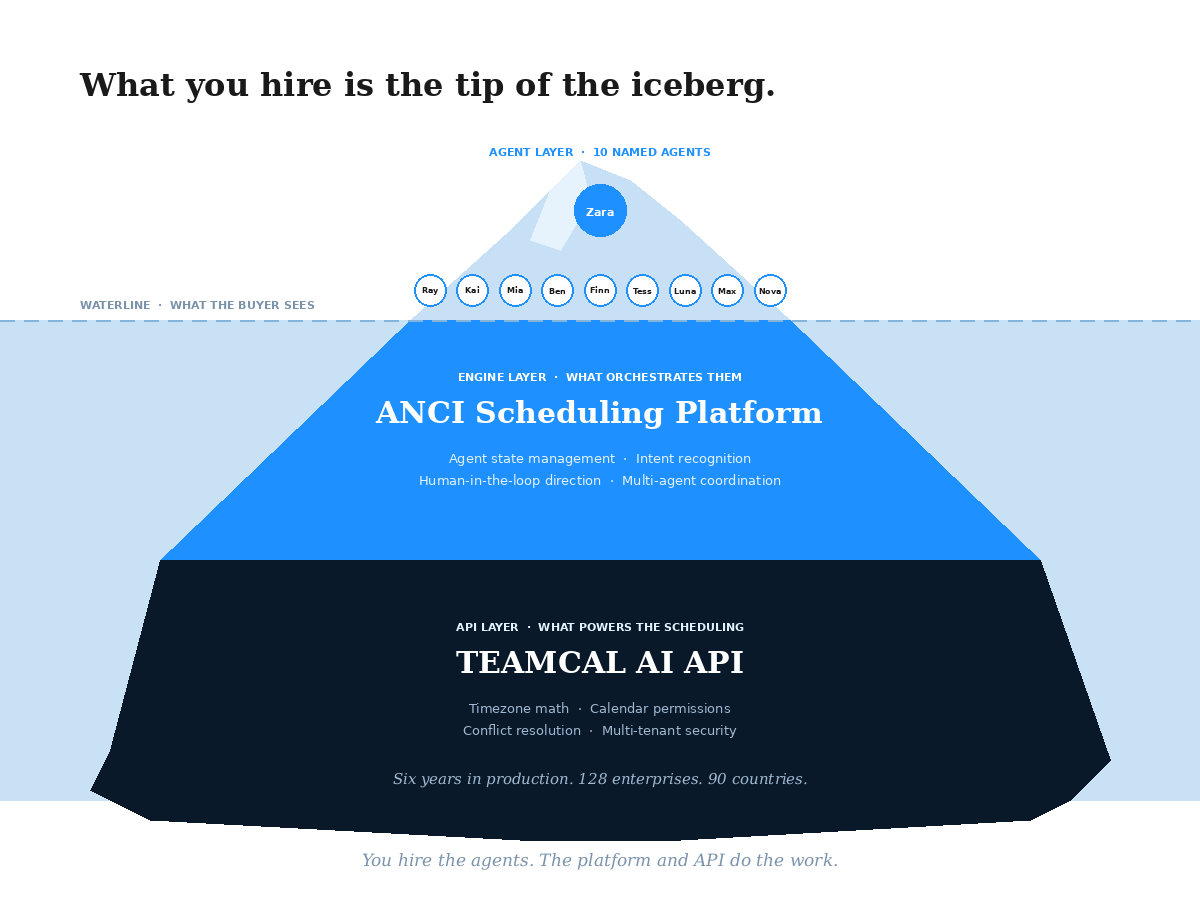
I want to be specific about what makes ANCI different from another AI scheduling tool, because there are a lot of those now.
The first thing is the engine. Every ANCI agent runs on the TEAMCAL AI scheduling engine. That engine has been in production for six years, has processed scheduling requests for 128 enterprises across 90 countries, and handles the brutal long tail of real-world scheduling: timezone math, calendar permissions, working-hour preferences, holiday calendars across regions, internal versus external meeting policies, recurring meeting hygiene, multi-calendar conflict resolution, room booking, video conferencing provisioning. The engine is not the agent. The engine is what makes the agent possible.
The second thing is that ANCI agents are not solo operators. They are directed. Zara is not trying to replace your EA. Ray is not trying to replace your recruiter. The architecture assumes a human partner. Your EA tells Zara what to do; Zara does it; your EA reviews. The trust gradient ramps up over weeks, not all at once. By month three, most companies running Zara have given her authority to schedule directly. By month one, she is still being directed turn-by-turn. We designed for this gradient deliberately.
The third thing is the data boundary. ANCI agents do not read your email. They do not access your files. They do not store the content of your calendar events. They operate on the scheduling layer (when, where, who) without touching the substance (what was said, what was decided, what was sensitive). The OAuth scopes ANCI requests are listed publicly in our IT administrator guide. The pre-filled vendor security questionnaire and GDPR DPA are publicly downloadable. SOC 2 Type II is in progress, targeted for Q4 2026.
The fourth thing is that ANCI agents are team-scale, not user-scale. You do not buy Zara for one executive. You buy Zara for your executive team. She serves your CEO and your CTO and your CFO from a single deployment. One agent, one price, whole team. The unit of value is what the agent does for the company, not what she does for one user.
What this means for existing TEAMCAL AI customers
If you are reading this as an existing TEAMCAL AI customer, three things to know.
First, nothing changes for your current deployment. TEAMCAL AI continues to operate exactly as it does today. Your accounts, your data, your integrations, your billing, your contracts. All the same. Your TEAMCAL AI subscription does not auto-upgrade to anything; if you want to add an ANCI agent, that is a separate decision and a separate contract.
Second, your data is portable across the two products because the engine is shared. If you decide later that you want to hire Zara to handle your executive scheduling alongside your existing TEAMCAL AI deployment, the migration is straightforward. We have a transition path documented for the handful of customers who have already asked about it.
Third, the team you work with at TEAMCAL AI is the team behind ANCI. Same engineering. Same support. Same account management. The brand is new; the people are not.
Who Zara is for
I want to be concrete about who should hire Zara today and who should wait.
Zara is for executive teams of three to fifteen people, where there is at least one EA or chief of staff already coordinating calendars. She is the agent your EA directs. If your CEO does not have an EA today, Zara is not what you need; you need an EA first.
The companies that are getting the most out of Zara have something in common: they have already accepted that scheduling work is not the executive's job. They have invested in a coordinator function. They are now looking at the cost of that function and asking whether the work needs to be done by a person or whether it can be directed.
If that is your situation, hire Zara today.
If you are a recruiting team, Ray is what you want. Ray enters early access this summer. Join the waitlist at meetanci.com/ray to be among the first cohort.
If you are in a specialized vertical — legal, healthcare, M&A, academic, events, internal ops, sales — the specialist agents are in development. Meet them at meetanci.com.
The bet underneath all of this
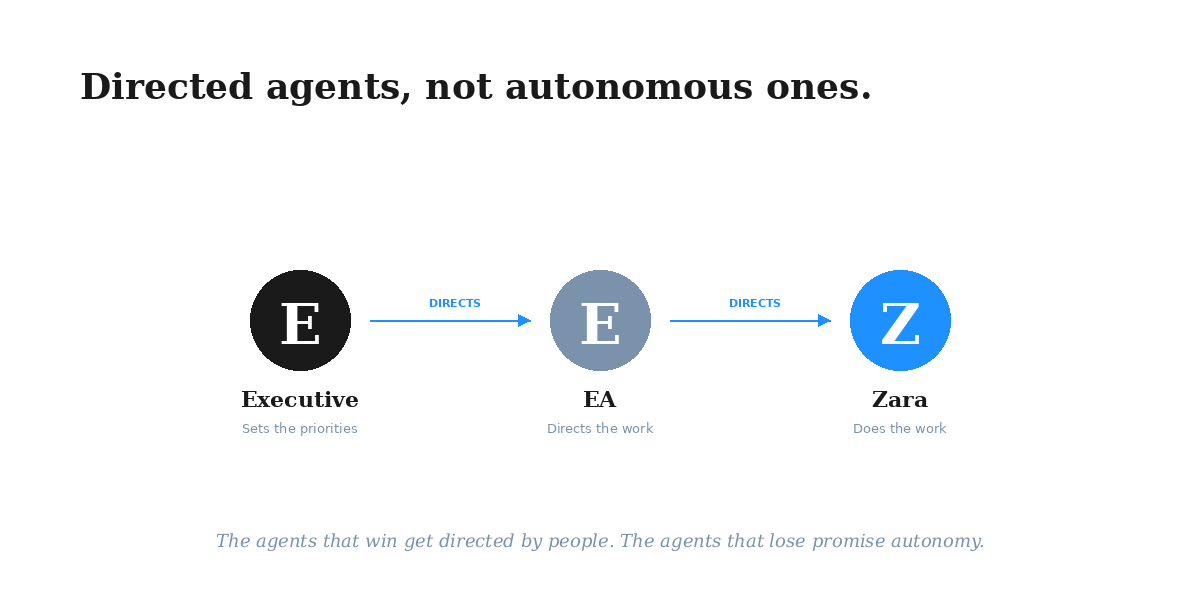
ANCI is a bet about how companies are going to organize work over the next five years.
The bet is this: the wave of AI agents that will actually stick are not the ones that try to replace people. They are the ones that get directed by people. The agents that win will be the ones with named jobs, accountable to named humans, embedded in the existing workflow rather than around it. The agents that lose will be the ones that promised autonomy and delivered chaos.
Scheduling is a small piece of the larger question. But it is a useful one to start with, because the work is well-defined, the value is measurable, and the trust gradient is easy to manage. If we can prove the model works for scheduling, the same architecture extends.
That is the bet. The proof starts with Zara.
If you want to see what it looks like in your company, we are taking ANCI discovery calls now.
Book a 30-minute conversation →If you want to read more about what we are building, the agent pages are live at meetanci.com.
If you are an existing TEAMCAL AI customer, thank you for trusting us this long. The next six years are going to be good.
— Raj
Get AI scheduling insights, product news, and Bay Area community updates delivered to your inbox.
No spam. Unsubscribe anytime.