LLM vs. NLP: Key Differences and Their Impact on Business Innovation
In the rapidly evolving field of artificial intelligence (AI), the terms Large Language Models (LLM) and Natural Language Processing (NLP) are frequently discussed, yet they are often misunderstood or used interchangeably. While both are deeply interconnected and centered around language understanding, they refer to different concepts and serve distinct roles in AI applications.

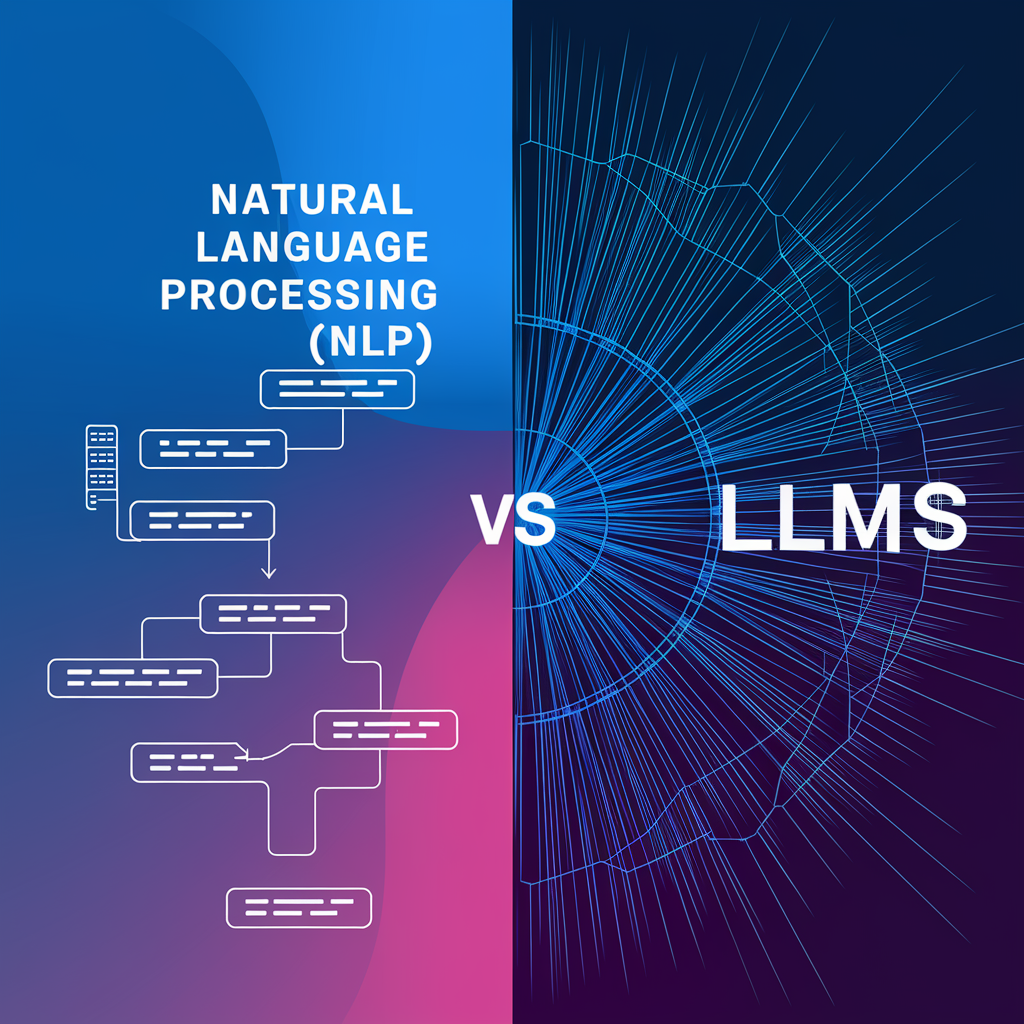
NLP and LLM work together synergistically to process, understand, and generate human language
What is Natural Language Processing (NLP)?
Natural Language Processing (NLP) is a subfield of AI focused on enabling machines to understand, interpret, and interact with human language. The goal of NLP is to bridge the gap between human communication and machine comprehension, which is a daunting task due to the complexities of human language. NLP encompasses a variety of techniques, including:
- Text analysis: Breaking down text into its structural components (e.g., sentences, words, parts of speech) to understand its meaning.
- Named Entity Recognition (NER): Identifying important entities within a piece of text, such as names, locations, and dates.
- Sentiment analysis: Determining the sentiment behind a text, whether it’s positive, negative, or neutral.
- Machine Translation: Converting text from one language to another.
- Speech recognition: Converting spoken language into text.
- Text summarization: Automatically generating concise summaries of large text bodies.
- Question answering: Develop systems that understand and respond to user queries conversationally.
NLP systems leverage a combination of linguistic rules, statistical models, and machine learning algorithms to process language. Over time, NLP has evolved, moving from rule-based systems to advanced machine learning and deep learning models, which significantly improved its accuracy and scalability. In the business world, NLP powers many applications, from chatbots to sentiment analysis, to help companies interact more effectively with their customers and manage large amounts of textual data.
What is a Large Language Model (LLM)?
A Large Language Model (LLM) refers to a specific type of deep learning model that uses massive amounts of text data to learn and generate human-like language. LLMs, such as GPT-4 (Generative Pretrained Transformer), BERT (Bidirectional Encoder Representations from Transformers), and T5 (Text-to-Text Transfer Transformer), are designed to understand context, generate coherent text, and perform a wide range of NLP tasks.
The primary features of LLMs include:
- Generative capabilities: LLMs can generate text that is coherent, contextually relevant, and often indistinguishable from human-written text.
- Contextual understanding: Unlike traditional NLP models, LLMs are capable of considering the broader context of words and sentences, which allows them to generate more natural and accurate responses.
- Few-shot learning: LLMs can understand tasks or instructions with minimal examples, enabling them to perform well in a variety of applications without extensive retraining.
- Multilingual proficiency: Many LLMs are trained on data from multiple languages, making them capable of working across linguistic boundaries.
LLMs operate using transformer architectures, which allow them to scale up to billions or even trillions of parameters. This enables them to capture incredibly detailed patterns in language, leading to remarkable performance in language generation and understanding tasks. Due to their size and complexity, LLMs require significant computational resources, and training them demands access to vast datasets and specialized hardware.
Key Differences Between LLM and NLP
Although LLMs are a part of the broader NLP field, they represent a specific and highly advanced approach to natural language understanding. Here are some key differences between NLP and LLMs:
Scope:
- NLP is a broad field that includes various techniques and methods for processing and understanding human language. It includes tasks such as machine translation, sentiment analysis, summarization, and more.
- LLMs are a specific type of NLP model that is characterized by their large scale, ability to generate coherent text, and remarkable language understanding capabilities.
Task Specialization:
- Traditional NLP models are often built for specific tasks (e.g., part-of-speech tagging, named entity recognition, sentiment analysis). These models are often designed to solve one problem well and may require manual feature engineering or task-specific training data.
- LLMs, on the other hand, are highly versatile and can handle a wide range of NLP tasks without needing extensive task-specific retraining. They can generate text, translate languages, answer questions, summarize information, and more, all with the same model.
Technology and Scale:
- NLP techniques include both rule-based systems (e.g., syntactic parsing) and machine learning models (e.g., decision trees, support vector machines), though many modern NLP models now rely on deep learning.
- LLMs rely on advanced transformer architectures and require enormous datasets and computational resources to train effectively. They are typically much larger and more resource-intensive than traditional NLP models.
Contextual and Generative Abilities:
- Traditional NLP models typically focus on understanding and classifying text, while LLMs can both understand and generate text that is contextually aware and semantically coherent. This makes LLMs ideal for applications that involve dialogue, content creation, or multi-turn interactions.
Business Implications of NLP and LLMs
For businesses, the distinction between NLP and LLMs has significant implications, both in terms of the capabilities these technologies offer and the value they can add to operations.
NLP in Business
- Automated Customer Support: NLP is already a key technology behind chatbots and virtual assistants, which can automate customer service tasks such as answering frequently asked questions, providing troubleshooting assistance, and even processing returns. This improves operational efficiency and customer satisfaction.
- Sentiment Analysis: By analyzing customer feedback, social media posts, and product reviews, businesses can use NLP to gauge public sentiment, identify trends, and make data-driven decisions. This is particularly valuable in marketing, where customer opinions shape brand strategy.
- Document Processing and Compliance: NLP helps businesses automate the extraction and analysis of data from documents, contracts, and emails, streamlining processes like contract review, legal compliance, and data entry. This reduces human error and increases productivity.
- Multilingual Capabilities: Companies with a global footprint benefit from NLP-powered translation services, enabling seamless communication across different regions. NLP tools can break down language barriers, improving cross-border collaboration and customer engagement.
LLMs in Business
- Advanced Content Creation: LLMs, like GPT-4, can generate human-like content for various applications, including blog posts, product descriptions, marketing copy, and even code. This drastically reduces content creation time, cuts costs, and helps maintain consistent messaging.
- Customer Engagement and Personalization: LLMs enable businesses to create more personalized and dynamic customer experiences. Virtual assistants and AI chatbots powered by LLMs can respond to customer queries in a natural, conversational manner, enhancing engagement and satisfaction.
- Business Intelligence and Data Insights: LLMs excel at processing vast amounts of unstructured data, such as news articles, research papers, and reports. They can synthesize and summarize information, providing businesses with real-time insights into market trends, competitor activity, and emerging opportunities.
- Internal Knowledge Management: LLMs can also be used to help businesses manage internal knowledge. By understanding and processing employee queries, an LLM can retrieve and summarize relevant information from company documents, knowledge bases, and wikis, making it easier for teams to collaborate and find the information they need quickly.
- Creative Problem Solving: In research and development (R&D), LLMs can generate new ideas, suggest innovative solutions to problems, and assist in brainstorming sessions. Their ability to understand and generate contextually relevant ideas can accelerate product development cycles.
To summarize, while Natural Language Processing (NLP) and Large Language Models (LLMs) both deal with understanding and generating human language, they differ in scope, complexity, and the tasks they can handle. NLP is a broader field that covers a range of language tasks, from sentiment analysis to translation, whereas LLMs are powerful models capable of understanding and generating complex, context-aware text on a massive scale. NLP is already enhancing customer service, sentiment analysis, and document automation. LLMs, on the other hand, are taking business applications to new heights by enabling advanced content generation, personalized customer experiences, and real-time data insights. As businesses continue to adopt these technologies, understanding how to integrate both NLP and LLMs effectively will be key to gaining a competitive edge and driving innovation in an increasingly AI-driven world.