Agentic AI Isn’t Just Better Prompting — It’s Better Context
Agentic AI shifts the focus from crafting better prompts to designing better context, where models operate in multi-step loops that use tools, memory, and state to make decisions. While prompt engineering improves individual responses, context engineering determines what information the model sees and how it reasons over time.

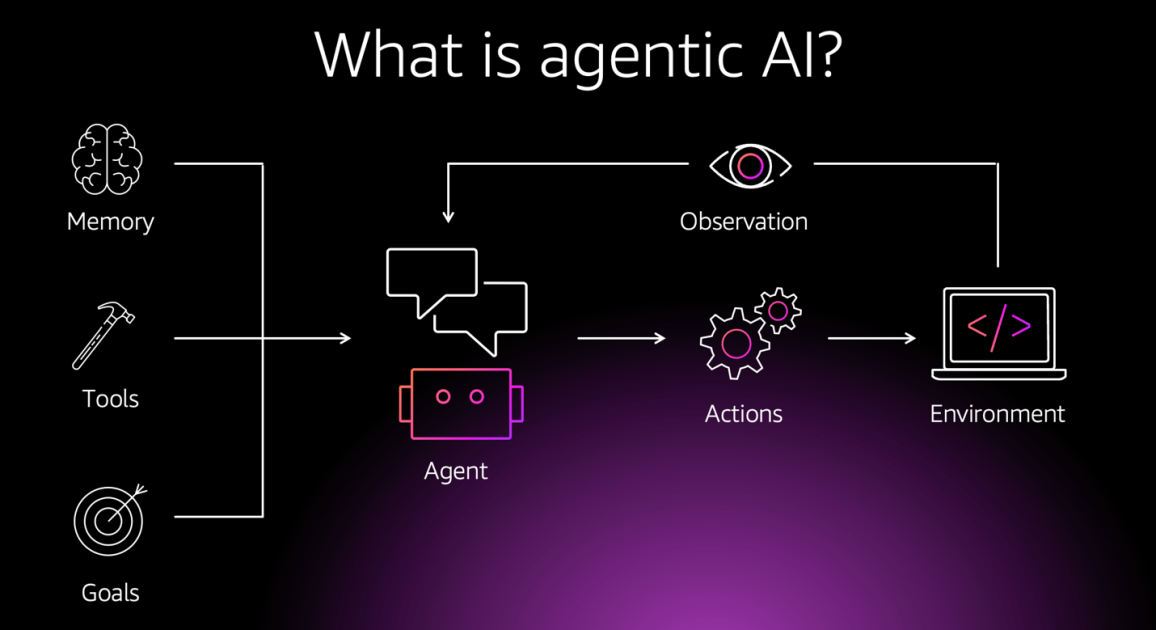
What is agentic AI?
Agentic AI systems operate in a loop. They interpret a goal, choose actions, call tools, observe results, update state and memory, and continue. Instead of producing a single answer and stopping, an agent behaves more like a small autonomous program embedded inside a software system.
Why prompt engineering stops scaling
Prompt engineering is effective when the goal is to improve a single response. However, once a system operates across multiple steps, relies on external tools, and depends on decisions made earlier in the workflow, the main source of failure shifts. In these settings, most errors come from missing, messy, or misleading context rather than from poorly written prompts.
Context engineering vs. prompt engineering
Prompt engineering shapes how the model responds, while context engineering shapes what the model knows. Context engineering determines what information is shown to the model, when it is presented, and how it is structured. This design of the information environment is what ultimately makes agentic systems stable and predictable.

The real failure modes
In practice, most agent systems fail because too much raw context — such as full conversation histories and unfiltered tool outputs — is passed to the model, because conflicting pieces of information are presented without structure, and because no explicit operational state is provided, causing the agent to repeat actions or replan unnecessarily. These failures are fundamentally context design problems.
What context engineering looks like in practice
Reliable agents depend on structured representations of state (such as goals, completed steps, and open constraints), selective retrieval of only the most relevant memories, and summarized or normalized tool outputs. The model does not need more information; it needs the right signals at the right time.
Why this changes how AI products are built
Modern agent systems now resemble software pipelines more than prompt templates:
retrieval → state → context composition → model → tools → memory
As foundation models converge in capability, teams increasingly differentiate through their context pipelines, memory systems, and agent architectures rather than through prompt design alone.
A quick example: scheduling agents
In scheduling assistants, the difficult problems are not extracting dates from text. The real challenges involve resolving time zone ambiguity, handling conflicting availability, tracking partial commitments, and preserving earlier decisions. These become tractable only when conflicts, preferences, and past actions are represented as structured context and explicit state.
The takeaway
Prompt engineering optimizes responses.
Context engineering optimizes decisions.
Agentic AI marks a shift from crafting better prompts to engineering better decision environments — and that shift is shaping how modern AI products are built.
Get AI scheduling insights, product news, and Bay Area community updates delivered to your inbox.
No spam. Unsubscribe anytime.