AI Meeting Scheduling
Benchmark Report
Real data from thousands of AI-scheduled meetings across 128 organizations. How Zara AI is transforming the way teams coordinate.
The Headline Numbers
Key takeaways from analyzing thousands of AI-scheduled meetings across 128 organizations.
- AI schedules meetings in ~49 seconds on average — replacing 15+ minutes of manual back-and-forth per meeting.
- Each AI-scheduled meeting costs just $0.056 in compute — less than a tenth of a cent per dollar saved.
- 51.75 hours saved in the last 30 days across the platform — that's over 6 full work days returned to teams.
- Rescheduling is the #1 use case (38% of all requests), followed by scheduling new meetings (32%).
- 2,963 users across 128 clients — with 86 new signups in the last 30 days alone.
- Power users average 69 AI-created meetings per month, proving AI scheduling scales with demand.
Platform Performance at a Glance
Real numbers from the last 30 days across all TEAMCAL AI clients.
How We Measured
All data comes from production systems. No surveys, no estimates — just real AI-scheduling activity.
Production Logs
Every metric is derived from actual Zara AI processing logs — real requests, real meetings, real costs.
30-Day Window
Data covers Feb 18 – Mar 19, 2026. A rolling 30-day snapshot of platform activity across all clients.
128 Organizations
Data spans organizations of all sizes — from solo professionals to enterprise teams with thousands of users.
What People Ask AI to Do
Breakdown of 1,318 Zara AI requests by intent type. Rescheduling dominates — the most painful scheduling task is the one AI handles best.
Request Distribution by Intent
"Rescheduling accounts for nearly 38% of all AI requests. This is the task that generates the most email back-and-forth — and the one where AI delivers the biggest ROI."
Meeting Volume Tiers
How different user segments leverage AI scheduling.
Top users create 69+ AI-scheduled meetings monthly, fully delegating calendar management to Zara.
Regular users average 15 AI-scheduled meetings per month, saving ~3.75 hours of coordination time.
Occasional users still save 30-75 minutes monthly, primarily using AI for rescheduling and finding times.
The Economics of AI Scheduling
AI scheduling isn't just faster — it's dramatically cheaper than the human time it replaces.
30-Day Cost Breakdown for a User
| Metric | Manual Scheduling | AI (Zara) | Improvement |
|---|---|---|---|
| Time per meeting | 15+ minutes | 49 seconds | ~95% faster |
| Cost per meeting | $5-8 (staff time) | $0.056 | ~99% cheaper |
| Monthly capacity (per user) | ~20 meetings | 69+ meetings | 3.5x more |
| Reschedule handling | 5-8 emails | 1 request | Zero back-and-forth |
| Timezone management | Error-prone | Automatic | 100% accurate |
| Availability after hours | None | 24/7 | Always on |
"At $0.056 per meeting, a team scheduling 200 meetings/month spends $11.20 on AI — versus $1,000–$1,600 in human coordination time. That's a 99% cost reduction."
Where AI Asks for Help
Not every request completes autonomously. Here's what causes Zara to pause and ask for human confirmation — and why that's a feature, not a bug.
| Blocker Type | Count | % of Total | Why It Happens |
|---|---|---|---|
| Awaiting Final Confirm | 122 | 27.1% | AI found the time — waiting for host approval before booking |
| Multiple Meetings Found | 103 | 22.8% | Ambiguous request matched several calendar events |
| No Availability | 67 | 14.9% | Calendars fully booked in requested window |
| Pending Approval | 66 | 14.6% | Meeting requires organizer sign-off before scheduling |
| Non-Organizer Reschedule | 40 | 8.9% | User tried to reschedule someone else's meeting |
Safety by Design
The top blocker — "Awaiting Final Confirm" — is intentional. Zara always confirms before booking on your behalf. This prevents accidental meetings and builds trust.
Disambiguation Intelligence
"Multiple Meetings Found" means Zara detected ambiguity and asked for clarification instead of guessing. Better to ask than book the wrong meeting.
Calendar Density
"No Availability" blockers reveal calendar overload. Zara flags this so teams can proactively manage their meeting load and protect focus time.
Permission Boundaries
Non-organizer reschedule attempts show proper access control. Zara respects calendar ownership and routes requests to the right person.
Before & After AI Scheduling
What changes when you let an AI handle your calendar coordination.
Without AI Scheduling
- 5-8 emails per meeting to find a time
- 15+ minutes of coordination per meeting
- Timezone errors and double-bookings
- Rescheduling restarts the entire cycle
- No scheduling outside business hours
- Meeting fatigue reduces productivity
- $5-8 in staff time per meeting
With Zara AI
- 1 natural-language request to schedule
- 49-second average processing time
- Automatic timezone detection and conversion
- Rescheduling handled in a single interaction
- 24/7 scheduling — even while you sleep
- Calendar intelligence protects focus time
- $0.056 per AI-scheduled meeting
Adoption & Platform Growth
How AI scheduling adoption is accelerating across organizations.
Users in the 30-Day Test
TEAMCAL AI users span 30+ countries and every major timezone — proving AI scheduling works across borders, languages, and work cultures.
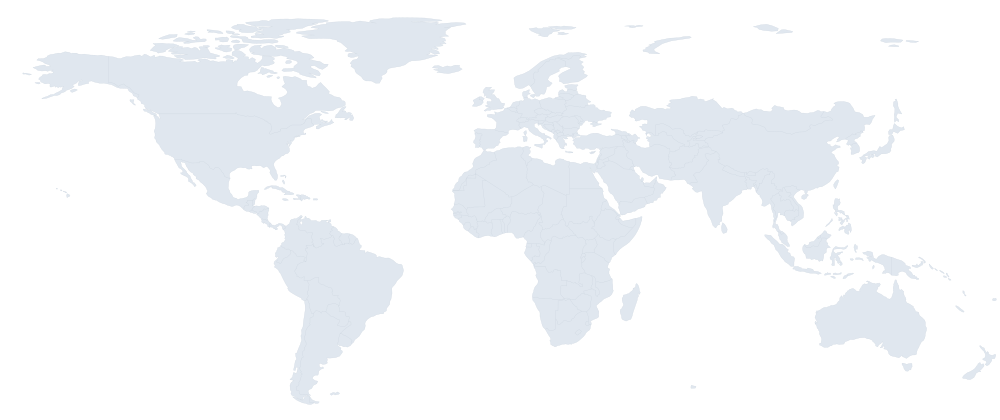
Users in the 30-Day Test
| Region | Top Cities | Users | Primary Timezone |
|---|---|---|---|
| US East Coast | New York, Boston, Nashville | 387 | America/New_York |
| US West Coast | Los Angeles, Mountain View, Palo Alto | 216 | America/Los_Angeles |
| US Central | Chicago, Houston, Austin, Dallas | 133 | America/Chicago |
| India | Hyderabad, Pune, Bengaluru, Mumbai | 73 | Asia/Calcutta |
| Western Europe | London, Berlin, Paris, Amsterdam | 65 | Europe/London, Europe/Berlin |
| Russia & CIS | Moscow, St. Petersburg | 35 | Europe/Moscow |
| Canada | Toronto | 25 | America/Toronto |
| Southeast Asia | Hanoi, Singapore, Manila, Bangkok | 31 | Asia/Saigon, Asia/Manila |
| Australia | Sydney, Melbourne | 17 | Australia/Sydney |
| South America | São Paulo, Santiago | 18 | America/Sao_Paulo |
"With users spanning from San Francisco to Sydney, AI scheduling eliminates the timezone math that causes 30% of cross-timezone meetings to be booked at the wrong time. Zara handles the conversion automatically."
The Scheduling Problem by the Numbers
Independent research confirms what our data shows — scheduling coordination is one of the biggest productivity drains in the modern workplace.
The Time Tax of Manual Scheduling
| Finding | Data | Source |
|---|---|---|
| Professionals spend scheduling meetings weekly | 3+ hours/week | Calendly, State of Meetings 2024 |
| Scheduling coordination as % of total work time | 7.5% | Reclaim.ai, Smart Meetings Report 2024 |
| Emails needed to organize one group meeting | 30 emails avg | Doodle, Scheduling Study 2019 |
| Meetings rescheduled per employee per week | 4.2 meetings | Reclaim.ai, Smart Meetings Report 2024 |
| Time workers lose to poorly organized meetings weekly | 71% of workers | Doodle, State of Meetings 2023 |
| Cost of unnecessary meetings per large company/year | $100M+ | Otter.ai & Dr. Steven Rogelberg (UNC Charlotte) 2022 |
Meeting Overload & Productivity Loss
| Finding | Data | Source |
|---|---|---|
| Average meetings per professional per week | 20.6 meetings | Reclaim.ai, 2024 |
| Time spent in meetings weekly | 14.8 hours (37%) | Reclaim.ai, Time Audit 2024 |
| Employees overwhelmed by number of meetings | 45% | Owl Labs, State of Hybrid Work 2024 |
| Meetings that come at the expense of deep thinking | 64% of professionals | Harvard Business Review, 2017 |
| Time communicating vs. creating at work | 57% vs. 43% | Microsoft Work Trend Index, 2025 |
| Focus time needed vs. actually available | 19.6h needed, 10.6h available | Reclaim.ai, 2024 |
| Hours lost annually to unnecessary meetings | 103 hours/year | McKinsey, 2023 |
Hybrid & Remote Work Complexity
| Finding | Data | Source |
|---|---|---|
| Meetings spanning multiple time zones | 30% (+35% since 2021) | Microsoft Work Trend Index, 2025 |
| Late-night meetings (after 8 PM) increase YoY | +16% | Microsoft Work Trend Index, 2025 |
| Companies now using hybrid work model | 75% | Archie, Hybrid Workplace Stats 2025 |
| Time lost per meeting to tech issues (hybrid) | 6+ minutes | Owl Labs, State of Hybrid Work 2024 |
| Workers who calendar-block to protect from meetings | 58% | Owl Labs, State of Hybrid Work 2025 |
"Inefficient meetings ranked as the #1 productivity disruptor by employees. Workers spend 57% of their time communicating and only 43% creating — scheduling automation addresses the most painful part of that communication overhead."
Industry Trends & Market Forecasts
Where the AI scheduling market is headed, according to leading research firms and analysts.
Market Growth Trajectory
The AI scheduling and meeting automation market is experiencing explosive growth.
28.2% CAGR. The AI meeting assistant segment is one of the fastest-growing in enterprise SaaS.
14.7% CAGR from $546M in 2025. Traditional scheduling tools are being replaced by AI-first solutions.
40.5% CAGR from $7.3B in 2025. Autonomous AI agents will transform how all enterprise workflows operate.
What Analysts Are Saying
| Prediction | Data | Source |
|---|---|---|
| Enterprise apps with integrated AI agents by end of 2026 | 40% | Gartner, 2025 |
| Enterprises deploying autonomous AI agents by 2027 | 50% | Deloitte, 2025 |
| AI productivity market shake-up through 2027 | $58 billion | Gartner, Strategic Predictions 2026 |
| Global productivity growth from AI corporate use cases | $4.4 trillion | McKinsey Global Institute, 2025 |
| U.S. work hours that could be automated today | 57% | McKinsey, Nov 2025 |
| Companies planning to increase AI investment (next 3 yrs) | 92% | McKinsey Global Survey on AI, 2024 |
| Businesses using AI in at least one function | 78% (up from 55% in 2023) | McKinsey Global Survey on AI, 2024 |
| Enterprise workflows automated by AI | 20%+ | Forrester, Predictions 2026 |
| Idle time reduction from AI-driven scheduling tools | Up to 40% | Forrester, 2026 |
AI Adoption in the Workplace
Async-First Movement
Organizations are converting status meetings into written updates and quick syncs into messages. AI scheduling supports this by protecting focus time and only scheduling what truly needs to be synchronous.
Proven ROI at Scale
Forrester's Total Economic Impact study found AI scheduling tools deliver 318% ROI over 3 years, saving enterprises 9,000+ hours and shortening recruiting cycles by nearly 6 days.
$58B Productivity Disruption
Gartner predicts GenAI and AI agents will create the first true challenge to mainstream productivity tools in 35 years, prompting a $58 billion market shake-up through 2027.
Discipline Over Experimentation
Forrester's 2026 outlook emphasizes this is the year where discipline matters more than experimentation — the winners will align AI technology with measurable economic value, not just pilot programs.
"AI could add $4.4 trillion in productivity growth from corporate use cases. Yet only 1% of companies describe their GenAI rollouts as 'mature.' The opportunity gap is enormous — and scheduling is one of the lowest-risk, highest-return entry points for enterprise AI."
Competitive Landscape
How the current market stacks up — from point solutions to AI-native platforms built for enterprise complexity.
Competitive Landscape
Platform Comparison
| Capability | Calendly | Clockwise | Reclaim AI | Motion | TEAMCAL AI |
|---|---|---|---|---|---|
| Automation Depth | Rule-based | AI-assisted | AI-assisted | AI-driven | Fully Autonomous AI |
| Natural Language | No | No | Limited | Limited | Full NL + Voice |
| Cross-team Coordination | No | Basic | No | No | Multi-team + Multi-org |
| Email/Chat Scheduling | No | No | No | No | Email, Slack, Teams |
| Agentic AI | No | No | No | Partial | Fully Agentic |
| Enterprise Security | Yes | Yes | Basic | Basic | Enterprise-grade |
| Primary Focus | Booking links | Calendar optimization | Individual scheduling | Task + scheduling | Full enterprise scheduling |
Why TEAMCAL AI Leads the Next Wave
Moving beyond simple booking links to fully autonomous coordination.
AI-First Architecture
Purpose-built for complex, multi-stakeholder scheduling — not a booking link with AI bolted on.
Natural Language & Voice
Schedule with one line via email, Slack, or voice through ADI — no forms, no links, no back-and-forth.
Cross-Team & Cross-Timezone
Orchestrates scheduling across entire organizations — handling time zones, preferences, and constraints seamlessly.
95% Time Reduction
Reduces scheduling coordination time by up to 95%, delivering immediate ROI from day one.
Enterprise-Grade Security
No calendar data stored. SOC 2 compliant. Built for organizations with strict security and compliance requirements.
Built for Enterprise Use Cases
Purpose-built for recruiting, sales, and executive operations — where scheduling complexity is highest and time is most valuable. See how TEAMCAL AI compares to Chili Piper for inbound lead routing.
"Unlike legacy tools that optimize individual calendars, TEAMCAL AI orchestrates scheduling across entire organizations — unlocking a new level of efficiency and coordination."
Strategic Implications
What business leaders and investors need to know about the shift to AI-powered scheduling.
Enterprise Standard Within 2–3 Years
AI scheduling will become a standard enterprise capability. Organizations that delay adoption will face growing coordination overhead while competitors accelerate.
Early Adopter Advantage
Organizations adopting AI scheduling today see 15–25% productivity gains. Every meeting scheduled by AI generates data that makes future scheduling smarter and faster.
Unlock Higher-Value Work
Automating coordination frees teams to focus on strategic work. Manual scheduling consumes 5–10 hours per employee per week — time that can be redirected to revenue-generating activities.
Agentic AI Redefines Work
The next phase isn't just AI-assisted scheduling — it's autonomous agents that act on behalf of users, negotiating times and coordinating across organizations without human intervention. Learn about the 7 types of AI agents driving this shift.
2026 AI Scheduling Predictions
Where meeting intelligence is headed based on the patterns we're seeing.
Fully Autonomous Scheduling
As AI confirmation rates improve, we expect 80%+ of meetings to be booked without any human intervention by year-end.
Predictive Calendar Intelligence
AI will proactively suggest meeting times based on patterns — "You usually meet with this team on Tuesdays at 2pm."
Cross-Organization AI Negotiation
AI schedulers from different organizations will negotiate meeting times directly — eliminating all human coordination overhead.
"The companies investing in AI scheduling today will have a compounding advantage. Every meeting Zara handles generates data that makes future scheduling smarter, faster, and more personalized."
Frequently Asked Questions
Ready to Save 95% of Your Scheduling Time?
Join 2,963 users who've already made scheduling their AI's problem.