The Agentic AI Revenue Stack
How founders operate the 4 phases of sales in the age of AI agents. A recap from the Right Side Capital Sales Bootcamp.

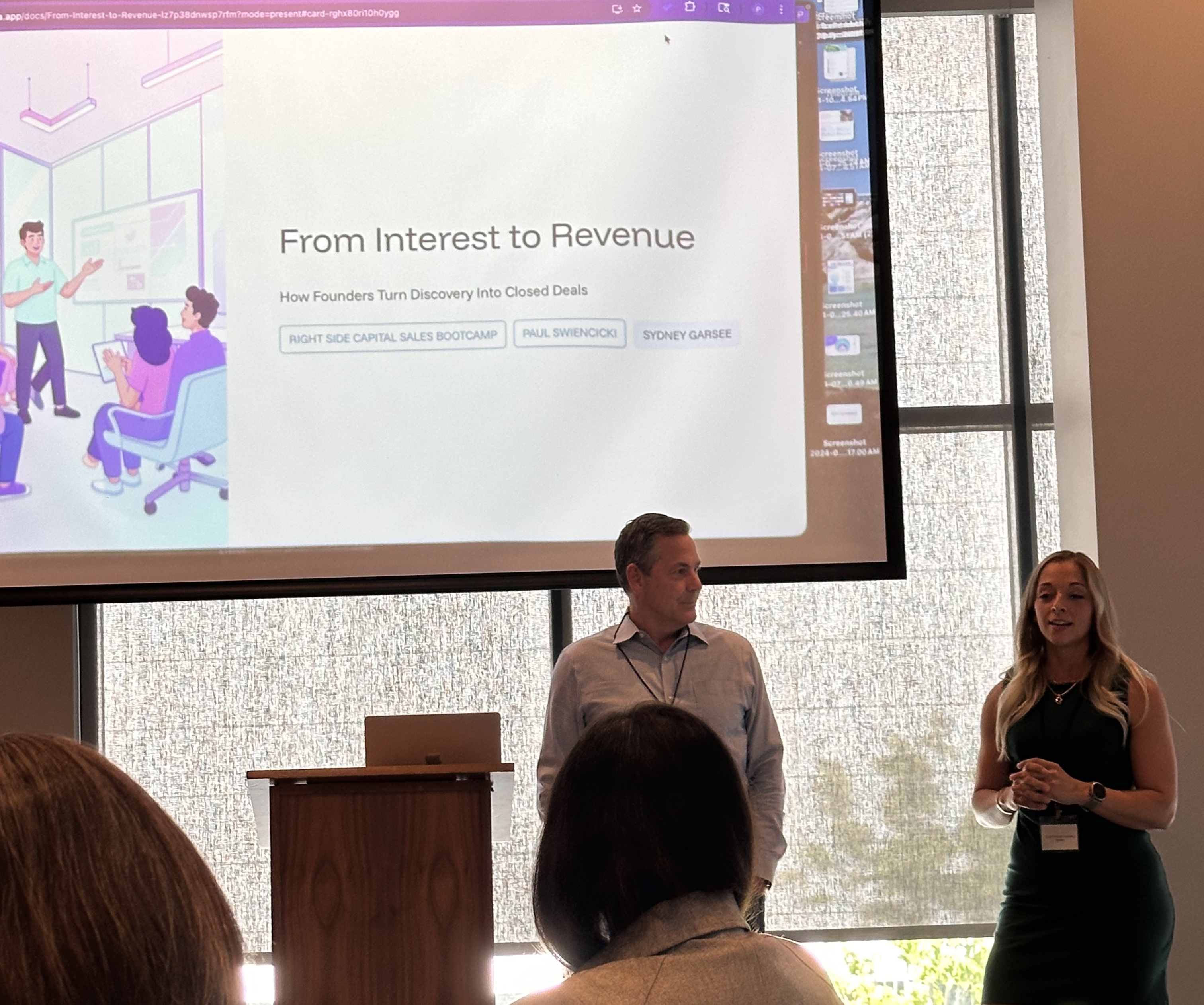
Paul Swiencicki and Sydney Garsee opening "From Interest to Revenue" at the RSCM Portfolio Founders programming.
Most early-stage founders treat sales like personality work. They walk into discovery calls hoping charisma will carry them, then wonder why qualified prospects go dark after the demo.
The Right Side Capital Sales Bootcamp, hosted as part of the RSCM portfolio founders programming, opened with a directly opposing premise. Sales is a structured process, not charisma. Each phase has a specific job. Master the sequence and you build something repeatable.
I went into the bootcamp with a builder's question on my mind. If sales is a structured system, where does the agentic AI layer plug in? I came out with a clearer answer than I expected. Paul Swiencicki and Sydney Garsee laid out a 4-phase framework that is not only the right human playbook for founder-led sales, it is also the right blueprint for where AI agents belong inside that playbook.
Call before the call, call after the call. This is essentially how I was successful in my entire career. Paul Swiencicki
The 4 Phases of Revenue
Paul reframed sales as a four-phase pipeline. Each phase has a clean handoff to the next. The point is not that any of these phases are new. The point is that most founder-led sales motions blur them. The bootcamp's value was forcing the operational separation: different tactics, different metrics, different owners.
The 4 Phases of Revenue, each with a clean handoff
Phase 1, the gift principle
Sydney covered Phase 1 in depth. Her core argument was that signal-based outbound has replaced volume outbound. The winning sequence is built around context, not cadence.
The first touch should look like a gift. Not a pitch, not a meeting request. Something the prospect would forward to a peer. Generic outreach loses to a single sentence proving you know what changed in the prospect's world this week. LinkedIn is the best tool for first contact in B2B, and email plus LinkedIn together outperforms either channel alone.
One tactic resonated with the room more than any other: the prospect dinner. Invite ten people in your ICP to a small event with no pitch. The relationship density you build in one evening outperforms three months of cold sequences.
Phase 2, the 8-step Discovery Framework
Paul walked through Phase 2 next, and this is where the bootcamp became most actionable. Every discovery call follows the same eight-step arc. Skip a step and you lose control of the conversation.
The 8-step Discovery Framework: every call follows the same arc
The mission statement is not a pitch, it's a filter. If it doesn't resonate, you're talking to the wrong person.

Paul walking through "Discovery Questions That Uncover Real Pain." The customer should talk most of the time.
Inside Step 05 sits the most underrated skill in founder sales: asking questions that unlock budget, urgency, and buying intent. Paul shared seven he keeps in rotation: What problem are you solving today? What happens if nothing changes? Why now, what changed? What is this costing the business? Who owns this internally? What does success look like? How are you solving this today?
What you are listening for is emotional language ("frustrated", "embarrassed", "losing sleep") and specific dollar or time costs. What kills discovery is jumping to a solution before pain is fully articulated.
Phase 3, the call before the call
The single most valuable insight of the entire bootcamp was Paul's framing of the demo cycle. Most founders treat the demo as the main event. Paul treats it as the middle of a three-call sequence.
The 3-call sequence: pre-schedule before the demo even happens
Five days before the demo, Paul calls his champion and asks for fifteen minutes to walk through what he plans to present. As he runs through it, he watches for reactions. When the champion says "we tried that and it didn't work," that becomes a moment Paul emphasizes in the live demo. When the champion says "don't go down that route," Paul cuts it.
By the time the live demo happens, three things are true. Paul is confident in the content. The champion has already validated the approach. And when there is dissent in the room, which there always is, the champion speaks up on Paul's behalf. The champion is no longer just a contact. They are functioning as an internal salesperson.
The call after the call is pre-scheduled before the demo even happens. "The demo is on the 7th. Can we book a call on the 10th to regroup?" Almost no one says no. On that follow-up, Paul asks directly: what do we need to do to get you signed? The answer is intel. Who is blocking. What pricing band the company expects. What internal approvals are required.
The 2-page contract
The most counterintuitive moment of the bootcamp was Paul holding up a 2-page contract and saying he had closed $100,000, $150,000, $250,000, and one $850,000 deal with it. The trick is structural: the contract does not contain twelve pages of terms of service, it contains a link to them. By Paul's numbers, 50 percent of customers sign as-is. Half of all deals close without a legal review. The simpler the document, the faster the signature.

The human spine of the framework. Everything that follows is the agentic AI layer Raj is building on top.
Phase 4, first value as a negotiation
Phase 4 begins the moment the contract is signed, and the first conversation is about scope. The customer will want everything. The job, Paul said, is to negotiate down to the single easiest win you can deliver fast.
First value is whatever the customer defines as success. Pick the version achievable in 30 to 60 days and protect everything else for later. This also protects your champion. They put their neck on the line by buying you. They need a visible, credible win before they can advocate for expansion.
The agentic AI overlay
Here is where the framework starts to matter for the next decade of founders. Each phase has a different ratio of agent-ready work to irreducibly human work. Knowing the ratio is how you build a revenue stack instead of a sales team.
The agentic AI overlay: each phase has its own agent-to-human ratio
Phase 1 is the most agent-native phase in the stack. Signal detection, ICP enrichment, contextual sequencing, personalized first-touch generation, channel coordination across LinkedIn and email. All of this is what vertical AI agents do better than humans and at a fraction of the cost. The founder's remaining job is taste: defining what counts as a gift worth sending, choosing which signals to act on, and showing up in person at the prospect dinner.
Phase 2 is hybrid, with the boundary at the discovery call itself. Pre-call research, account briefs, question preparation, and post-call summarization are all agent work. What agents cannot do is the live listening: catching emotional language, following pain three layers deep, knowing when to stay silent. Discovery is a human skill enhanced by agent preparation.
Phase 3 is where the agentic AI thesis pays back the fastest. The call before the call requires research and message rehearsal, both agent strengths. Business case construction is exactly the kind of multi-source synthesis vertical agents excel at. Contract generation from a 2-page template is one prompt. Coordinating the call after the call with the champion's calendar is precisely what TEAMCAL AI was built for.
Phase 4 is where the agent earns the renewal. First value tracking, onboarding milestones, weekly check-in scheduling, expansion signal detection across product usage and CRM data. Agents close the loop between contract and revenue. The human owns the trust, the champion relationship, and the expansion conversations that matter.
Agents do the volume, the prep, the coordination, and the closing of loops. Founders do the judgment, the listening, and the moments that require taste.
The takeaway
The bootcamp gave me the human spine. Sales is an engineering discipline. The 4 Phases as a clean pipeline. The Discovery Framework as a repeatable conversation. The call before the call as a system, not a hustle. The 2-page contract as deliberate friction reduction. The negotiated first value as a protected commitment.
The agentic AI layer is the next architectural pass. The founders who build both layers well will compound. The founders who build only one will not.
Build your revenue stack with TEAMCAL AI
Zara, our AI scheduling agent, runs the coordination layer behind every phase of revenue: prospect dinners, discovery calls, demos, the call before the call, and the call after. 128 organizations across 90 countries already trust her.
Start freeGet AI scheduling insights, product news, and Bay Area community updates delivered to your inbox.
No spam. Unsubscribe anytime.