Hands-On Agentic AI for Product Leaders
What happens when 52 Silicon Valley builders, executives, and product leaders spend 90 minutes actually building AI agents, no code required. A recap of TEAMCAL AI's sold-out Palo Alto workshop.

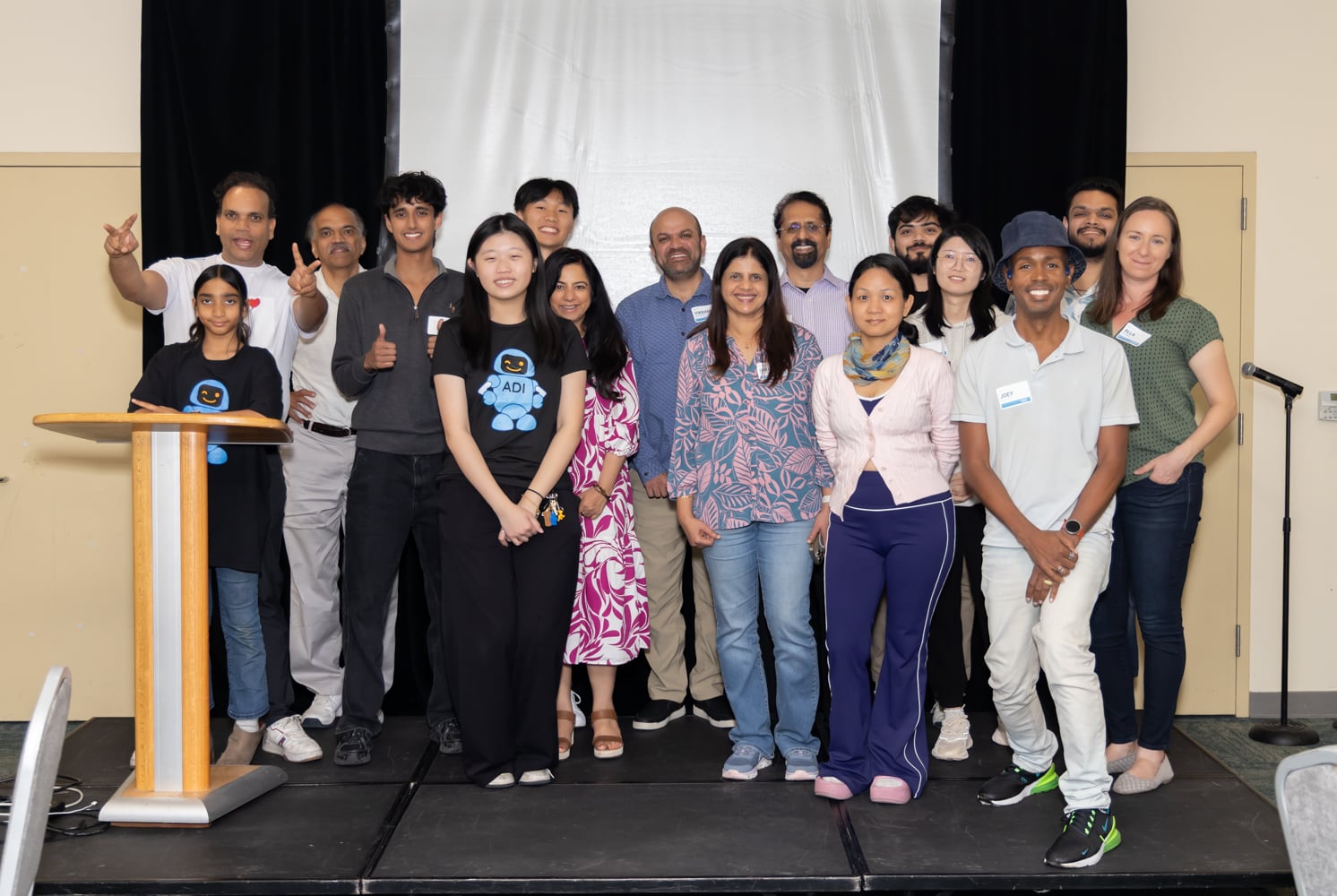
On the evening of March 26, product leaders from across Silicon Valley gathered at the Oshman Family JCC in Palo Alto for something unusual: a workshop that promised to teach them agentic AI, hands-on, without writing a single line of code. Hosted by TEAMCAL AI and the Igniter Silicon Valley community of Stanford entrepreneurs and founders, the sold-out event delivered exactly that, and more.
Who showed up, and why
The registration data tells a story of its own. Of 52 attendees, 43% held VP, Director, C-suite, or Founder titles. Product managers made up the single largest functional group, followed closely by engineers who wanted to understand the product implications of agentic systems. The audience was cross-functional by design, and that tension made the conversations richer.
Product leadership
VPs of Product, CPOs, Product Managers, Principal PMs, Product Owners
Engineering
Software Engineers, System Architects, CTOs, Technical Program Managers
Executive
CEOs, Co-founders, Directors of Innovation Strategy, Operating Managers
Adjacent roles
Consultants, Advisors, AI Risk Associates, Sr. Directors of Marketing
When asked what they wanted to learn, attendees did not say "understand AI better." They said build. The most common phrases in their registrations were "hands-on," "no code," "deploy," and "agents." These were not curious observers. They were practitioners looking for an on-ramp.
One registration stood out for its directness: "I want to turn my ideas into working prototypes and beyond." That sentence could have been the workshop's tagline. Sixteen attendees signed up specifically for future events, before the evening even began.
Why this workshop, why now
AI is no longer a feature you ship. It is the way you build. But for product managers and executives, the challenge is not understanding that AI matters. It is knowing what to do with it on Monday morning. That gap, between knowing and doing, is what the 90-minute session was designed to close.
Led by Raj Lal, Founder and CEO of TEAMCAL AI, former UX lead at MobileIron and SpaceIQ, and Stanford Summer instructor, the session was built for product leaders who want to move from AI curiosity to AI fluency. The framing opened with a Feynman quote that set the tone for everything that followed:
Stop reading about AI agents. Start building them.
From LLMs to agents: the key distinction
The workshop opened with a framing that many in the room had not fully internalized. A large language model can answer questions. An AI agent can act. It plans, executes, and reports back. It is an autonomous application built on top of an LLM that can define its own persona, ask clarifying questions, maintain context across interactions, and take real actions: booking meetings, sending emails, querying databases, generating forecasts.
This is the agentic loop: observe, plan, act, refine, repeat. And 2026 is the year this architecture has gone mainstream. The workshop mapped this into seven distinct agent types, from a basic tool-using model all the way to fully autonomous multi-agent systems. Attendees did not just study the taxonomy. They built working examples of four types before the evening ended.
The question for product leaders is not whether to build with AI agents. It is which of the seven types fits your use case, and where you put the human in the loop.
The four builds
-
1
Gemini Executive Assistant (Type 1) Try it live →Every attendee had a working AI agent in under 10 minutes. Using Google Gemini with Workspace extensions, they built a personal executive briefing that filters urgent emails, flags external meetings, identifies deep work blocks, and delivers a prioritized action summary at 7:30 AM every weekday. The result replaced 20–30 minutes of manual inbox scanning, daily, permanently.
-
2
Claude AI PM Agent (Type 2, MCP) Try it live →Using Claude and Model Context Protocol servers, attendees built a senior PM agent that takes a 1–3 sentence feature description, asks pointed clarifying questions, generates a full PRD with user stories and success metrics, produces a sprint backlog ready for Jira, and delivers a ranked risk analysis. Work that typically takes days completed in 15 minutes.
-
3
Competitive intelligence pipeline (Type 3, sequential) Try it live →Using Claude Code, attendees built a three-stage pipeline: fetch competitor GitHub data, categorize strategic signals and calculate health scores, then generate a self-contained HTML competitive dashboard. The Fetch, Analyze, Report pattern is reusable for any market research or business intelligence workflow.
-
4
Human-in-the-Loop Scheduling Assistant (Type 6) Try it live →Using AI chaining across ChatGPT for planning and Claude for code generation, participants built a scheduling assistant that can display calendars, find slots, draft outreach, and manage meetings, but pauses for human approval before every consequential action. This is the architecture that carries agentic AI into organizations that have something to lose.
What the audience was really asking
The peer sharing circle at the close of the workshop surfaced something the registration data had already hinted at. The anxiety in the room was not technical. It was strategic. People were not asking "how does this work." They were asking "what happens to my role."
One attendee, a CEO, had written in his registration: "How AI impacts Product Management roles and the skill gaps to fill to stay on the job in the AI era." He was not alone. Engineers wanted to know how to be great product managers with AI. Product managers wanted to know how to prototype without engineering. Directors wanted to know how to run multi-agent systems without a technical team.
The future workshops people asked for reveal where the market is heading: AI adoption and security, AI tools for professional productivity, physical AI and robotics, and the skills gap in product management as AI reshapes the role itself.
Six things every product leader should take away
- You do not need to code to build AI agents. Every exercise used no-code or low-code approaches with Gemini, Claude, and ChatGPT. If you have been waiting for a technical co-founder before you start, the wait is over.
- The agent taxonomy matters. Understanding the seven types helps you choose the right architecture for each use case. Not every problem needs a fully autonomous system. Most enterprise problems start at Type 6.
- Human-in-the-loop is the enterprise sweet spot. Confirmation gates before consequential actions are not a limitation. They are the trust mechanism that gets agentic AI adopted inside organizations that have something to lose.
- AI chaining across models is the real unlock. Using ChatGPT for planning and Claude for building is not redundant. It is leveraging each model's strengths in a single workflow. Multi-model is the architecture of serious products.
- Sequential pipelines are your new business intelligence layer. Fetch, Analyze, Report. Apply it to competitive research, customer feedback synthesis, market sizing, or any workflow that currently requires a human analyst across three tools.
- Start with your morning. The executive assistant exercise proves the highest-ROI AI adoption often starts with automating your own daily routine. Reclaim 30 minutes a day and you have already justified the investment.
The agentic AI revolution is not coming. It is here, and it showed up in Palo Alto on a Wednesday evening in the form of 52 people who left with working prototypes instead of slide decks.
TEAMCAL AI builds the world's most advanced AI scheduling software for teams. Learn more at teamcal.ai.
Get AI scheduling insights, product news, and Bay Area community updates delivered to your inbox.
No spam. Unsubscribe anytime.