Understanding the AI Market: The Tools Everyone Is Racing to Master
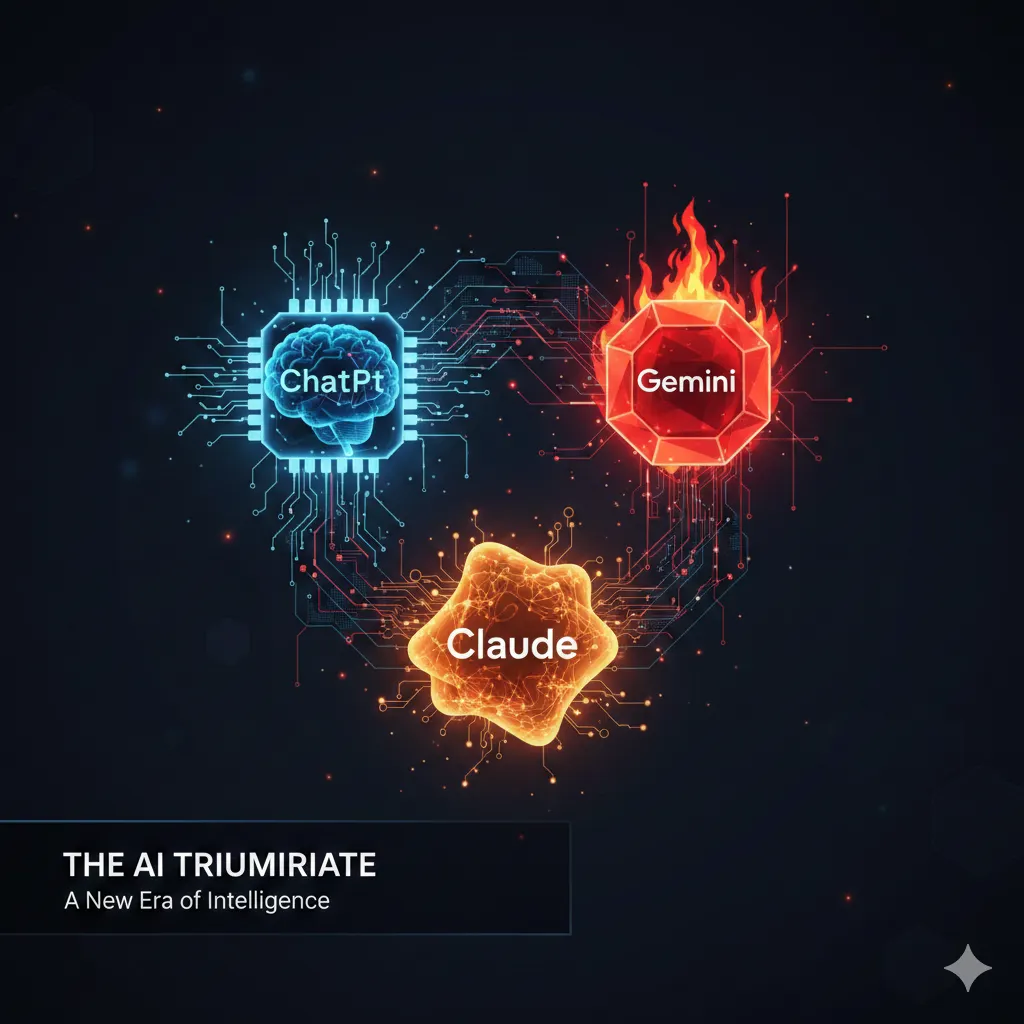
This text serves as a strategic breakdown of the modern AI landscape, advocating for a shift from using a single chatbot to building a "composed intelligence" stack. By categorizing ChatGPT as the versatile everyday assistant, Gemini as the integrated operations layer for Google Workspace, and Claude as the precision tool for deep engineering, it argues that a user's competitive advantage no longer comes from finding the "best" model, but from knowing exactly which specialized ecosystem to deploy for a given task. Ultimately, the piece positions AI as the new foundational infrastructure for developers and founders, where the fastest builders are those who can seamlessly orchestrate these different layers of intelligence to eliminate workflow friction.

“How did you finish that so fast?”
“Wait… AI did that?”
That reaction has become normal.
Since the release of ChatGPT, the AI landscape has been evolving at a pace the tech world has rarely seen. What started as a conversational novelty has rapidly expanded into a full ecosystem of coding agents, research copilots, and terminal-native AI tools.
Today, staying “caught up” in AI feels almost impossible.
New models drop monthly. Benchmarks shift weekly. Entire workflows get automated overnight.
Developers, students, founders, and curious builders are all asking the same question:
Which AI tools actually matter — and how should you use them?
In this deep dive, we’ll break down three of the most influential AI ecosystems today and, more importantly, when each one gives you a real advantage.
ChatGPT + Atlas + Codex
The Everyday Intelligence Layer
ChatGPT remains the most widely adopted AI assistant — and for good reason. Its core strength is simple but incredibly powerful:
It understands what you mean and gives you usable answers fast.
At its current state, ChatGPT excels at:
- Following nuanced instructions
- Producing clean, readable outputs
- Performing deep multi-step reasoning
- Handling both technical and general questions
With features like speech-to-speech on iOS, strong research capabilities, and massive practical versatility, ChatGPT has evolved into what many consider the default daily AI companion.
Where ChatGPT Wins
ChatGPT is strongest when you need:
- Rapid explanations
- Research synthesis
- brainstorming and ideation
- Structured writing
- General problem solving
It’s the model you keep open all day — the one that quietly removes friction from dozens of small tasks.
For most users, ChatGPT isn’t just useful.
It’s workflow glue.
Gemini + Nano Banana + Google AI Studio + NotebookLM
The Google Ecosystem Powerhouse
When Google launched Gemini, it wasn’t just another chatbot release — it was an ecosystem play.
Gemini’s biggest differentiator is its deep, native integration with the Google stack. Unlike standalone models, Gemini can directly interface with:
- Google Docs
- Gmail
- Google Sheets
- Google Drive
- Google Meet (in some workflows)
- Google Slides
This turns Gemini into something more than an assistant.
It becomes an organizational control layer.
Where Gemini Wins
Gemini shines when your workflow lives inside Google Workspace:
- Summarizing long document threads
- Automating email workflows
- Organizing Drive content
- Working across large knowledge bases
- Multimodal tasks (text + images)
For operators, students, and teams deeply embedded in Google’s ecosystem, Gemini can quietly eliminate hours of manual coordination.
Think of it less as a chatbot…
…and more as an intelligent operations assistant.
Claude Code + Claude CLI
The Engineer’s Power Tool
If ChatGPT is the daily driver and Gemini is the operations layer, Claude Code has quickly become the engineer’s precision instrument.
When Anthropic released Claude Code, adoption among developers was immediate — because it targeted something very specific:
Real coding workflows, not just code snippets.
Claude Code stands out in several areas:
- Large-context reasoning across big codebases
- High-quality artifact generation
- Strong multi-step problem solving
- Terminal-native workflows via Claude CLI
With newer Opus-class models pushing toward massive context windows (approaching the million-token range), Claude has become particularly attractive for:
- Monorepos
- Large refactors
- Complex debugging sessions
- Long reasoning chains
Where Claude Wins
Claude is often the best choice when you need:
- Deep code understanding
- Large repository navigation
- Careful multi-file edits
- Terminal-integrated AI workflows
- High-reliability reasoning
Claude CLI is especially powerful because it lives directly inside your development environment. It can create, edit, and manage files while assisting with real engineering tasks — not just answering questions in a chat box.
For serious builders, this is a big shift.
AI is no longer just advising the workflow — it’s inside it.
The Real Takeaway: Don’t Pick One — Build a Stack
The biggest mistake people make right now is trying to crown a single “best” AI model.
That’s the wrong frame.
The winners in this new AI era aren’t the people who pick one tool.
They’re the people who know when to use each one.
Quick Tactical Guide
Use ChatGPT when you need:
- Fast research
- Clear explanations
- Writing help
- Everyday problem solving
- Brainstorming
Use Gemini when you need:
- Google Workspace automation
- Document and email orchestration
- Multimodal Google-native workflows
- Large knowledge organization
Use Claude when you need:
- Serious coding work
- Large-context reasoning
- Terminal-based workflows
- Careful multi-step engineering tasks
Final Thoughts
We are no longer in the phase where AI is a novelty.
We are in the phase where AI is becoming infrastructure.
The developers and builders who move fastest over the next few years won’t just be the smartest coders or the best writers.
They’ll be the ones who understand how to compose intelligence — stacking the right models, in the right places, at the right time.
And right now…
We’re still early.