Why AI Is Changing How Work Gets Done, Not Just How Fast
Silicon Valley veteran Hon Wong explains why AI is not another productivity tool. It is a fundamental shift in who does the work, and what that means for leaders.

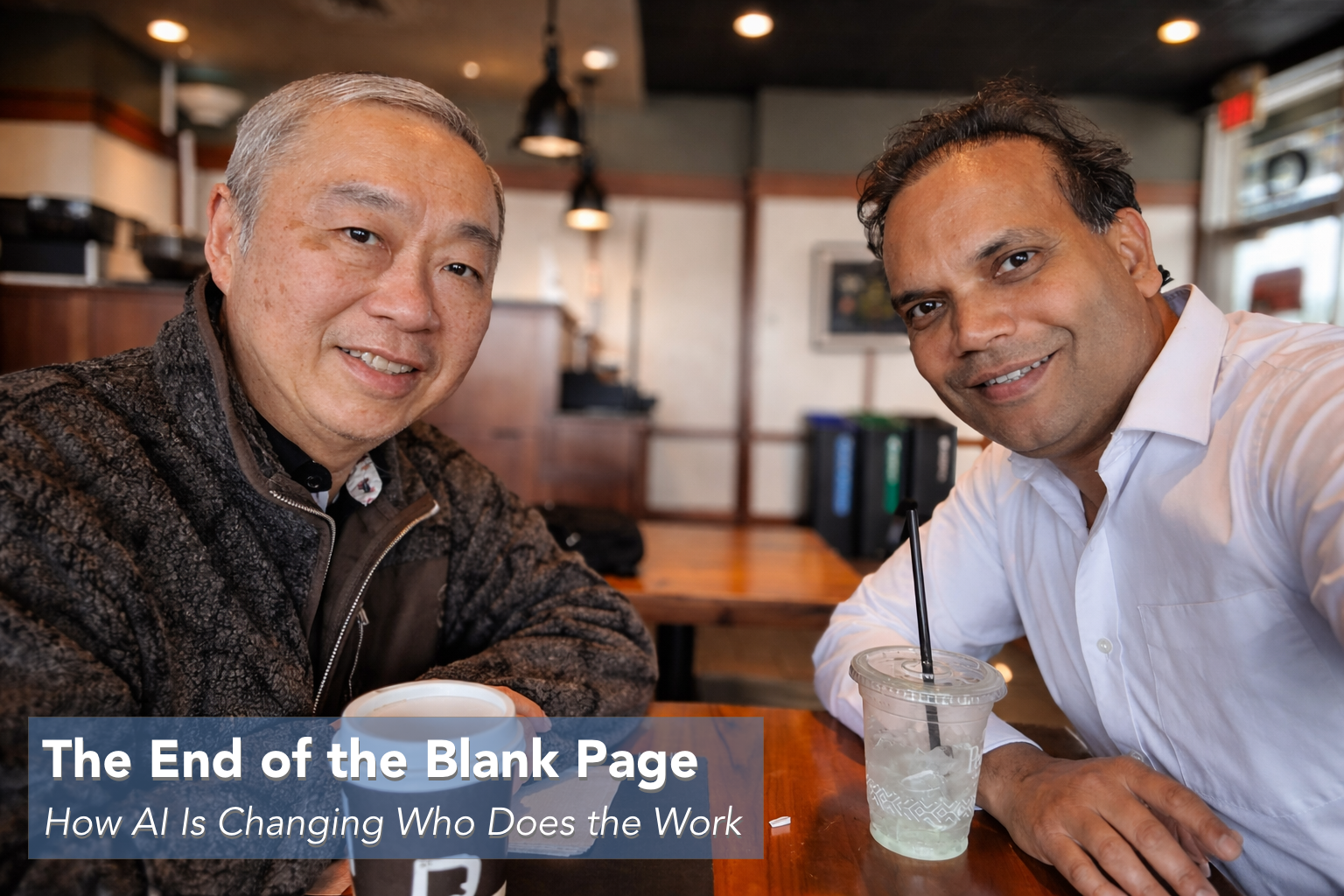
Artificial intelligence is often described as the next wave of technology. But most definitions miss what actually makes it different. Previous technology revolutions helped organizations work faster. AI crosses a different line, it can perform parts of the work that once required human thinking.
Databases stored information more reliably. Networking moved it more quickly. Cloud computing made access more flexible. Each wave was about efficiency: the same work, done better. AI is categorically different.
Few people have watched multiple technology cycles as closely as Hon Wong. As a founder, investor, and advisor to numerous Silicon Valley startups, he has helped companies navigate every transition from early internet software through SaaS and cloud. In this conversation with AI Edge for Leaders, Wong explains why AI represents something categorically new, and what leaders need to understand before it is too late to adapt.
AI is changing who does the work
Every major technology wave reshaped the tools people used. AI is reshaping the workforce itself.
"In past waves, technology helped us store, move, or access information more efficiently," Wong explains. "AI goes a step further, it can actually do parts of the work that used to require human thinking."
This distinction matters enormously for leaders. When AI can analyze, summarize, generate, and automate significant parts of a workflow, the question is no longer just how to work faster. It is who or what is doing the work in the first place.
"It is not just improving how we work," Wong says. "It is changing who or what is doing the work."
That reframe changes every conversation about hiring, team structure, workflow design, and competitive strategy.
From blank page to first draft
The clearest way to see this shift is inside the actual work of teams.
At the 2026 Game Developers Conference, a recurring theme was how organizations are rethinking everyday workflows from the ground up. Companies like Ubisoft are already applying this in production. They built an internal AI tool called Ghostwriter to handle background dialogue for non-playable characters. In the past, writers manually created thousands of small lines of dialogue. Now, they prompt AI to generate variations, then review and select the best ones.
The role of the writer did not disappear. It transformed. Writers moved from producers to directors and curators.
A similar shift is happening in design. Instead of starting from scratch, artists generate a wide range of concepts using AI, then iterate on the most promising directions. Work becomes a back-and-forth process rather than a blank-page exercise.
The pattern is consistent across industries: less time spent on repetitive creation, more time on judgment, taste, and creative direction. Wong captures this transformation in one of the most useful framings for leaders today:
The blank page is going away. In a few years, nobody will start from zero. Your first draft will almost always come from working with AI, and the job shifts to shaping and refining it.
Hon WongWhy AI adoption is harder than it looks
Despite the clear potential, AI adoption regularly falls short of expectations inside organizations.
The most common mistake is treating AI like software. Leaders deploy it as a tool, announce the rollout, and expect results. That approach underestimates what actually needs to change.
"Many leaders treat AI like a tool you can roll out and be done with," Wong says. "In reality, it changes how work gets done at a basic level."
The barrier is not technology access. It is trust and workflow redesign. As Wong puts it: "The challenge is not access to technology. It is changing workflows, building trust, and helping teams use it effectively."
If team members do not trust the outputs, or if AI is added on top of existing processes rather than integrated into them, the impact stays minimal. The organizations that succeed are the ones that redesign how work flows, not just the tools they use to do it.
Rollout is the easy part. Redesign is the work. Until workflows are rebuilt around AI outputs, and teams trust those outputs, efficiency stays on a PowerPoint slide.
Where competitive advantage now comes from
AI is also forcing a rethink of how companies compete.
"AI makes it easier and cheaper to build products," Wong explains, "which means there is going to be more competition."
When the tools are widely accessible, speed alone no longer creates a durable advantage. Building faster than the competition used to be enough. Today, a competitor can replicate your product in weeks using the same AI tools you used.
"The advantage now comes from having something others cannot easily copy," Wong says. "That could be unique data, strong customer relationships, or being deeply embedded in a customer's workflow."
Differentiation has shifted from technology capability to context and integration. The companies that win will be the ones that are hardest to replace, not just the ones that built something new.
Smaller teams, bigger impact
Looking ahead, AI is likely to reshape the structure of organizations in ways leaders are not yet fully accounting for.
Wong expects AI to absorb the data-heavy coordination work: analysis, summaries, reporting, scheduling, documentation. What remains for humans is the work that requires genuine judgment. "People will focus more on judgment, context, and decision-making," he says.
The result is a fundamentally different kind of organization. "Teams will likely get smaller and more capable," Wong says. "A few people with the right tools will be able to do work that used to require much larger groups."
This brings real opportunity and real responsibility in equal measure. Leaders must think carefully about accuracy, security, and the risk of overreliance on AI, while also ensuring teams stay engaged, confident, and genuinely skilled working alongside it.
What this means for leaders
AI is often framed as a breakthrough in technology. Its real impact is organizational.
The shift is not faster tools. It is a redefinition of how work begins, evolves, and gets completed. The blank page metaphor captures this perfectly: when the first draft comes from AI, the human role shifts from origination to direction, from creation to curation, from execution to judgment.
Success will not come from simply adopting AI. It will come from redesigning workflows, building organizational trust in AI outputs, and developing the human skills that AI cannot replicate.
The organizations that adapt fastest will not just work more efficiently. They will work differently.
Leadership thinking on AI, workflow design, and the future of work, delivered monthly from the TEAMCAL AI editorial team.