How Claude Code Works: A Field Guide at Three Altitudes
The most consequential agentic AI tool of 2026, explained at three levels of detail. Pick the one that starts at your altitude. Then keep climbing.

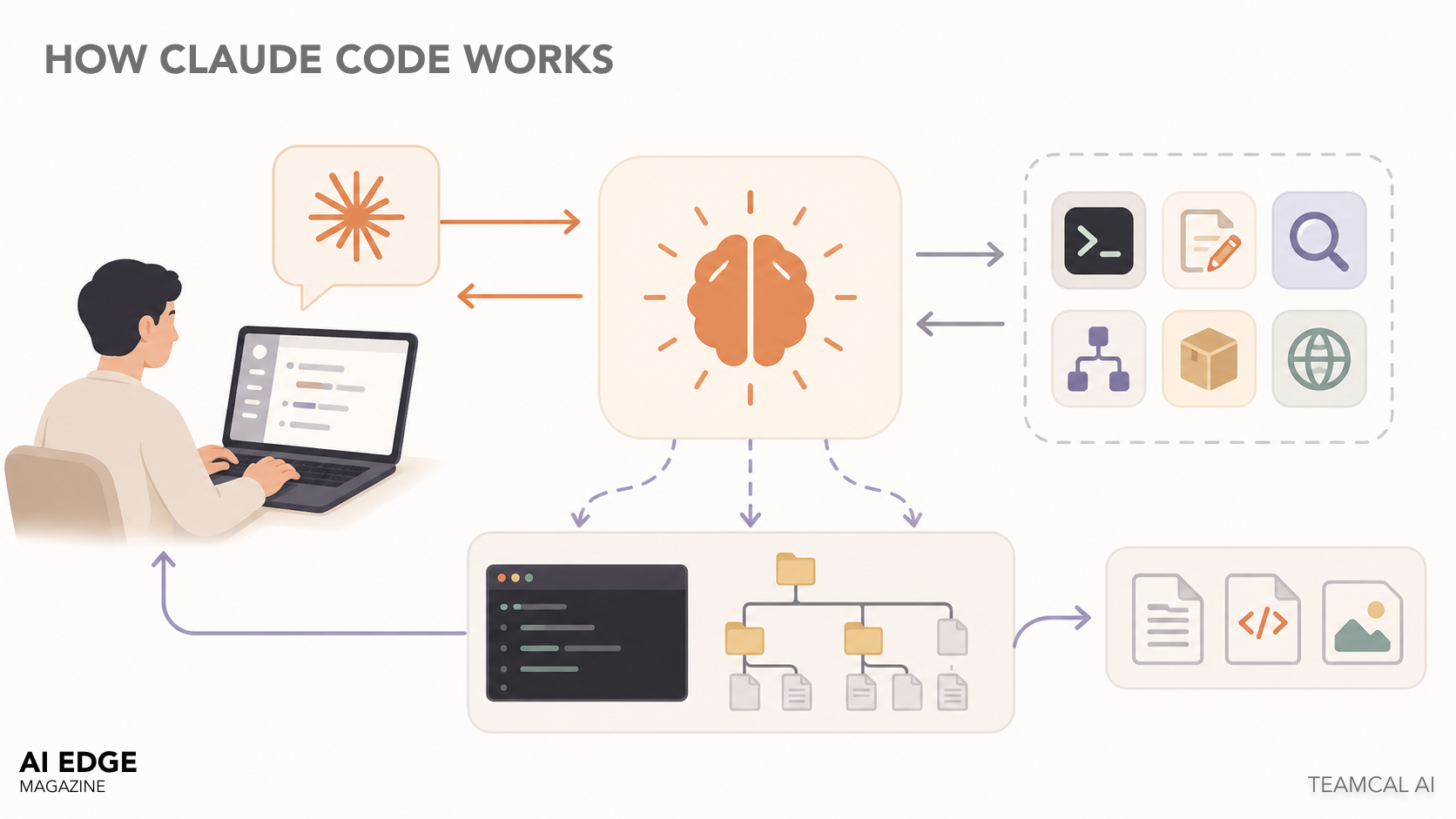
Claude Code is, depending on who you ask: a robot with hands, a senior engineer you can hire for pennies, or an AsyncGenerator-based ReAct loop with discriminated-union message dispatch. All three descriptions are true. They are just at different altitudes.
Most explainers about Claude Code pick one altitude and lose the other readers. The deeply technical ones lose executives in the second paragraph. The marketing ones lose engineers in the first. The "AI for everyone" ones lose both.
This field guide takes a different approach. We have written the same explanation three times, at three levels of detail, using the same underlying mental model. Each version is complete on its own. Read the one that starts at your altitude. If you want to keep climbing, the next one up will reinforce what you just learned rather than restate it.
Three Articles. Pick Your Altitude.
The three deep-dives are linked at the bottom of this article. Each runs ten to twelve minutes. Here is what each is about and who it is for.
Article 1 — How Claude Code Works in Plain English
For the curious non-engineer. The leader's spouse. The new hire who keeps hearing the term in standup. We explain Claude Code through a working metaphor: a system with a brain, a set of hands, eyes, and a memory. No code. No jargon. Just a clean mental model that holds up under questioning.
Read this one if you have never opened a terminal but want to understand what every engineer at your company is suddenly so excited about.
Article 2 — Claude Code for Executives
For C-suite and senior operators. The strategic case for Claude Code, written in the register of a board memo. Cost economics, the redeployment thesis, the safety model, the capability spectrum across the SDLC, and the one question to ask your CTO this quarter.
Read this one if you are deciding whether to invest in agentic AI tooling and need to understand the actual economics, not the marketing.
Article 3 — The Architecture of Claude Code
For software engineers and technical leads. The deep architectural breakdown. AsyncGenerator pipelines, the ReAct core loop, the dependency-injected permission system, write-ahead transcript persistence, and the six patterns composing the whole system. Code samples included.
Read this one if you are evaluating Claude Code for adoption, building your own agentic system, or just want to know what is happening under the hood.
Why Three Versions, Not One
This is a question worth answering. Most technical explainers pick one audience because that is the only audience the writer can imagine. The result is a publication system that fragments people. Engineers read engineering blogs. Executives read executive blogs. Curious non-technical readers get nothing or get marketing material that condescends to them.
Claude Code is consequential enough that all three of those audiences need a working understanding of it. The version your CTO reads should not be different from the version your CFO reads in any way that matters. Same system. Same model. Different vocabulary.
The other reason is internal. We at TEAMCAL AI write a lot about agentic AI. The infrastructure behind Claude Code is the same infrastructure shape that powers our own scheduling agent, Zara. Understanding one helps you understand the other. Which is what gives this explainer its longer shelf life: it is not just about Claude Code. It is about how this whole class of system works.
A Note on the Order
You do not have to read all three. But if you do, the order matters less than you think. Engineers benefit from reading the plain-English version first because it cleans up sloppy mental models that crept in from blog posts. Executives benefit from reading the engineering version after the executive one because the architectural details give them sharper vocabulary in conversations with their CTO.
Pick whichever opens the door for you. Then keep going.